
Are you looking forward to applying to secure operational license with NCC, Let me walk you through every process you need to get NCC license for sales and installation in Nigeria
The Nigerian Communications Commission (NCC) is an agency saddled with the responsibility of regulating Nigeria’s telecommunications industry to ensure that telecom services and equipment meet approved standards.
If you intend to sell, install, deploy, maintain, or provide technical support for telecommunications equipment in Nigeria, obtaining the appropriate NCC license or authorization may be necessary depending on the nature of your business.
Whether you operate an ICT company, telecom engineering firm, internet service provider, security systems company, fiber optics installation business, or telecommunications equipment dealership, understanding the NCC licensing process is essential for legal compliance and business credibility.
In this guide, you’ll learn everything you need to know about obtaining an NCC license for sales and installation in Nigeria, including the eligibility requirements, registration process, required documents, applicable fees, processing timeline, and frequently asked questions.
What is An NCC License in Nigeria?
NCC license is an official permit issued by the Nigerian Communication Commission as an approval for individual and companies to legally operate in the telecommunications industry, provide services relating to data acquisition and management, or use frequency spectrums in Nigeria.
In Nigeria, the Commission is governed by Section 31 of the Nigerian Communications Act of 2003, which makes it a legal offense to engage in telecom activities or infrastructure in Nigeria without first securing the license from the right authority.
Who Needs an NCC License in Nigeria?
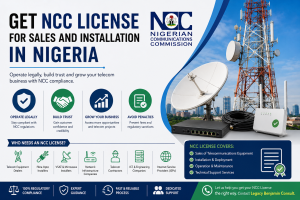
Below is a comprehensive list of businesses that needs the NCC license to operate legally in Nigeria
- Telecom equipment dealers
- ICT companies
- Financial technology companies
- Internet Service Providers (ISPs)
- Fiber optic installation companies
- Network infrastructure companies
- Telecom contractors
- Radio communication companies
- VSAT installers
- Microwave equipment installers
- Telecommunications engineering companies
Please note that licensed data protection consultants does not need NCC license to operate.
Can You Sell Telecom Equipment Without an NCC License?
No. It is a crime and offense punishable by law to engage in the sales, distribution and even manufacture of telecom equipments without first applying for NCC license.
Types of NCC Licenses in Nigeria
If you are looking forward to applying for the NCC license, it is important to understand which category fits your industry.
The license is grouped in 2 major categories such as
- Individual License: This license is specifically for telecom companies that posses large infrastructure, such as mobile network operations like the Glo, MTN, Airtel, internet services, and fiber optic cabling.
- Class License: This is for small scale and sometimes road side businesses with small shops such as cybercafés, public payphones, and equipment sales and installation.
Individual License
This category comprises of multinational telecom companies in Nigeria wioth large organization infrastractures. E.g MTN being owned by South Africa and Glo being owned by a Nigeria and vice versa
- Wholesale Wireless Access: It is used to establish mobile and fixed wireless networks, such as radio and satellite dish systems, for voice, data, and video communications.
- Open Access Fibre Infrastructure: The licensee is needed to build, maintain, and operate fibre optic networks within the licensed area, providing Layer 1 and Layer 2 network services.
- Value Added Services Aggregator: Used to provide secure connections between VAS Content Providers and Network Service Providers, enabling the transmission of value-added services.
- Private Networks Links (National): Used to provide and operate Private Network Links within some designated Licensed Area using cable, microwave, radio, or a combination of these technologies.
- Value Added Services (Special Numbering Services): Used to provide and operate Special Numbering Services across Nigeria, offering value-added and enhanced telecommunications services.
- Value Added Services (Content Services using Short Codes): Used to provide and operate Value Added Services (Content Services Using Code Numbers) in collaboration with licensed network operators in Nigeria.
- Value Added Services Call Centre Service: With this license, you can be able to provide and operate Call Centre Services in collaboration with licensed network operators in Nigeria.
- Regional Private Network: Holders of this license are authorized to provide and operate Private Network Links using microwave, radio, or a combination of these systems within the designated area.
- Value Added Services (Call Directory): The licensee is authorized to provide and operate Call Directory Value Added Services within Nigeria.
- Submarine Cable Infrastructure & Landing Station Services: Used to land, install, operate, and manage an international submarine cable in Nigeria.
- Prepaid Calling Card Services: The licensee is authorized to provide and operate prepaid card calling services, allowing subscribers to make calls using automated code dialing with allocated Personal Identification Numbers (PINs).
- National Carrier: Under this license, the license holder is authorized to provide and operate Fixed Terrestrial Networks using Radio, Cable, or Satellite for point-to-point and multipoint communications involving voice, data, and video transmission.
- Digital Mobile Licence (GSM): This is for those that want to operate, and maintain a National Public Land Mobile Network (PLMN) for digital mobile radio telephony services in the 900MHz and 1800MHz bands.
- Unified Access Service: The licensee is authorized to construct, operate, and maintain an International Gateway and a telecommunications network using radio, cable, or satellite for voice, data, and video transmission.
- Public Mobile Communications (Vehicle Tracking Services): The licensee is authorized to install and operate fixed and mobile data networks for vehicular tracking services. These networks enable the transmission and reception of data to determine vehicle locations efficiently.
- Public Mobile Communications (Trunk Radio Services): The licensee is authorized to install and operate fixed and mobile trunk radio networks for virtual private telecommunications services within the licensed area.
- Public Payphone Services: The licensee is authorized to provide and operate public payphones, including facsimile transmission over payphone lines.
- Non-Commercial/User Operated Radio Networks: The Licensee is authorized to operate Non-Commercial Private Network Links using Satellite (VSAT) systems strictly for data traffic. Voice traffic deployment is not permitted under this Licence.
- National Long Distance Operator: The Licensee is authorized to construct, maintain, and operate Access Tandems and transmission facilities, carry long-distance traffic within Nigeria, and establish Points of Presence for interconnection with Private Networks and Access Providers.
- Metropolitan (Fibre) Cable Network: The Licensee is authorized to construct, maintain, and operate Access Tandems and Fibre Optic Transmission Facilities, using alternative transmission media where necessary.
- Internet Services: Used to provide and operate Internet services within the designated area, ensuring connectivity for users.
- International Gateway: Used to construct, own, and operate an International Gateway for providing international access and communication services via radio, cable, or satellite.
- International Data Access Gateway: The Licensee is authorized to provide and operate International Data Access (IDA) connectivity for voice, data, and video transmission within Nigeria and internationally.
- Interconnect Exchange: This is used for handling local and national traffic, establishing Points of Presence, and leasing or building transmission networks where necessary, subject to regulatory approval.
- Sales & Installation of Terminal Equipment: This license is required for the installation and sale of cellular and other telecommunications terminals, including handsets, modems, fax machines, cordless phones, and switching equipment up to 100 lines.
- Infrastructure Sharing & Collocation Services: This Licence authorizes the provision of collocation and infrastructure sharing services to licensed network service providers. It allows the Licensee to build, construct, or acquire telecommunications infrastructure and facilities for sharing, excluding core network facilities
- Global Mobile Personal Communications System (GMPCS): This Licence authorizes the construction, operation, and maintenance of a GMPCS Land Earth Station for communication with a GMPCS system.
- Fixed Wireless Access (FWA): This Licence authorizes the provision of telecommunications services using a fixed communications system for voice, video, and data transmission.
- Electronic Directory Information Services: This Licence authorizes the provision and operation of Electronic Directory Information Services within Nigeria.
- Domestic VSAT Networks: This Licence authorizes the provision and operation of VSAT services for voice, data, and video transmission within Nigeria and internationally.
- Central Equipment Identity Registry: This Licence authorizes the Licensee to register and maintain a database of all mobile subscribers and handset details in Nigeria.
Class License
- Tele-centre: which allows for the operation of community based telecom access points.
- Repairs & Maintenance of Telecom Facilities: It is used by companies to offer maintenance and repair services for telecom infrastructure.
- Public Payphone Services: The license authorizes users to set up and operate public phone booths on the roadsides and in busy areas within the streets of Nigeria
- Sales and Installation of Terminal Equipment: This license allows small businesses to sell and install communication devices and equipment.
- Cabling Services: Enables companies to lay and maintain telecom cables for various networks.
- Cybercafé Operations: This is where internet cafés with public access are established and controled
Which NCC Licence Covers Sales and Installation Services?
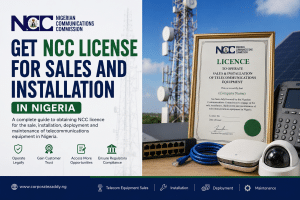
The Sales and Intallation of Terminal equipment license under individual category is the license required to engage in sales and installation services under the Telecom industry.
NCC Licence For Sales and Installation in Nigeria: Documents
Individual License Application Document Requirements
- CAC Certificate of Incorporation
- Current Tax Clearance Certificate
- Payment of non-refundable fee being 5% of Licence fee
- Certified True Copy (CTC) of Articles & Memorandum of Association
- NDPC license (Where applicable)
- Electronic copy of passport photographs of Directors/Shareholders of the company
- Electronic copy of passport photographs of authorized representative
- Feasibility report of proposed service
- Certificate of qualified technical staff (where applicable)
- Corporate Affairs Commission (CAC) status report
- Utility Bill reflecting the Official Address of the Company
- Evidence of funding
- Memorandum of Understanding (where applicable)
- If the company is an existing licensee (type of license issued to the Company)
- The amount budgeted for the project
Guide To Apply For NCC License for Sales and Installation in Nigeria
- Register your company with CAC
- Determine the appropriate NCC licence category.
- Prepare all supporting documents.
- Submit your application by visiting the eservices.ncc.gov.ng and click on Licensing Application Management System to apply
- Upon submission of the application, a Class Administrative fee of Ten Thousand Naira (₦10,000.00) is payable via the Licensing Application Management System (LAMS).
- Undergo NCC evaluation
- Receive approval
- Obtain your NCC licence
For Renewal of an Existing NCC Licence
- Navigate to the “Licences” menu page, then click on the “eye icon” to view the details of your existing licence, thereafter, click on the “Renew” button to begin your licence renewal application.
- Please also note that all Licence Fee payments will be made during the application process. You are not required to make any payment on eservices before you begin your application proces
NCC License Cost For Sales and Installation in Nigeria
For Individual Sales and Installation of terminal equipment
- Including satelite communications terminal equipment is and valid for 5 years
- Including Switching equipment of more than 600-line capacity & major network ₦2,000,000 and valid for 5 years
For Class License Application: Sales & Installation of Terminal Equipment
This Licence shall be for the sales and installation of Mobile Phone, Fixed Telephone handsets, Modem, Cordless phones, Fax machines, PABX and sale of airtime. A one time payment of ₦10,000
Read more for Full NCC license fee in other line of operation.
Benefits of Getting an NCC Licence
- Operate legally
- Build customer confidence
- Qualify for government contracts
- Access telecom projects
- Improve business credibility
- Regulatory compliance
- Avoid sanctions and penalties
Common Reasons NCC Licence Applications Are Delayed
- Wrong licence category
- Incomplete documentation
- Incorrect company information
- Non-payment of fees
- Poor technical documentation
Frequently Asked Questions
Do I need an NCC licence to sell telecom equipment in Nigeria?
Yes. You need the license to operate legally
Do telecom equipment installers require an NCC licence?
Yes. The license is very important to operate legally for sales and installation of telecom equipments
How much does an NCC licence cost in Nigeria?
Kindly check out the Full NCC license fees
How long does it take to obtain an NCC licence?
It takes about 2 to 4 weeks
Can a business name apply for an NCC licence?
No. Only limited liability companies are approved to apply
Can foreigners obtain an NCC licence in Nigeria?
Yes. If they meet all regulatory requirements
Can an NCC licence be renewed?
Yes. Individual license are expected to be renewed after 5 and 10 years respectively
Conclusion
Obtaining an NCC license is an important step for businesses involved in the sale, installation, deployment, or maintenance of telecommunications equipment and services in Nigeria.
The appropriate license not only ensures compliance with the Nigerian Communications Commission's regulations but also enhances your company's credibility, increases business opportunities, and protects you from regulatory penalties.
Since NCC licensing requirements vary depending on the specific telecom service or activity, it is important to identify the correct license category before submitting your application. Working with experienced regulatory consultants can also simplify the process and help avoid costly delays.



Comments 0
No comments yet
Be the first to share your thoughts.
Leave a Comment
Your email will not be published.