
Obtaining an NCEC Certificate has become an important requirement for many businesses and organizations operating in regulated sectors in Nigeria. Whether you are applying for government contracts, seeking corporate compliance, onboarding with large organizations, or meeting industry-specific requirements, understanding the NCEC certificate registration process can save you time, money, and unnecessary delays.
Although many applicants search for NCEC Certificate Registration Online, they are often confused about the actual registration requirements, how it relates with the NOGIC JQS portal, the cost of obtaining the certificate, the documents needed, and the steps involved in the application process. Missing a single document or submitting incorrect information can result in delays or rejection.
In this comprehensive guide, you’ll learn everything you need to know about NCEC and NOGIC JQS Certificate Registration Online in Nigeria, including what each certificate or registration means, their relationship with the Nigerian Content Development and Monitoring Board (NCDMB), eligibility requirements.
Whether you’re registering as an oil and gas contractor, vendor, supplier, engineering firm, logistics company, or consultant, this guide will help you navigate the registration process with confidence.
What is an NCEC Certificate?
The Nigerian Content Equipment Certificate (NCEC) is a document issued by the Nigerian Content Development and Monitoring Board.
This document helps to verify that service companies, manufacturers, and operators possess the needed local capacity, equipment, and facilities to execute projects in Nigeria’s oil and gas sector.
Who Needs an NCEC Certificate?
The following categories of entities needs the Nigerian Content Equipment Certificate in Nigeria.
- Companies
- Contractors
- Government vendors
- Consultants
- Manufacturers
- Importers (if applicable)
Benefits of Obtaining an NCEC Certificate
Below are the benefits of obtaining the Nigerian Content Equipment Certificate in Nigeria.
- Having the NCEC certificate is a strong signal of regulatory compliance
- It gives rise to improved business credibility, customer trust and positive goodwill
- Companies who have this document are eligible to apply for government contracts
- Corporate recognition
- Easier vendor registration with big companies like shell, Seplat energy, NNPC, Oando and other big companies occupying major oil sectors
- It gives rise to business expansion opportunities
Where Does the NCEC Certificate Fit in the Nigerian Oil and Gas Industry?
The NCEC is a cornerstone of the Nigerian Oil and Gas Industry Content Development (NOGICD) Act of 2010. It bridges the gap between imported foreign technology and Nigeria’s goal of industrial self-reliance by enforcing the Equipment Component Manufacturing Initiative (ECMI).
We can not discuss NCEC certification without mentioning the agency responsible for issuing this certificate and the online portal where registration is carried out.
NCEC certificate is also a major product of the NCDMB’s regulatory framework, specifically under the Equipment Component Manufacturing Initiative (ECMI)
What is NCDMB?
The Nigerian Content Development And Monitoring Board (NCDMB) is a Federal Government Board Established Under the NOGICD Act of 2010.
The role of NCDMB is to monitor and implement all local related content policies across the entire Nigerian oil and gas industry.
The core function of this Board is to create industry guidelines, manage the Nigerian Content Development Fund and issue multiple types of approvals and certificates to enforce local capacity building and structure
In addition, the board also award certificates of authorization for projects that complies with the Nigeria content provisions
What is the NOGIC Act?
The NOGIC Act otherwise called the Nigerian Oil and Gas Industry Content Development (NOGICD) Act, is a 2010 law designed to increase indigenous Nigerian participation in the petroleum sector.
This Act mandates that local companies, materials, and labor be given first consideration in all oil and gas projects to retain economic value within Nigeria
Difference Between NCEC, NCDMB Registration and JQS Registration
While this 3 terminologies can seem very confusing, it is very important to understand the clear difference between the 2.
One thing is certain that you can not legally and effectively operate in the oil and gas sector in Nigeria without needing these documents or at least doing a registration that requires using the JQS portal.
1. NCDMB: This is the regulatory body that oversees the implementation of the Nigerian Oil and Gas Industry Content Development (NOGICD) Act. Just like we have CAMA 2020 in Nigeria that provides the law that governs CAC operations in Nigeria, this includes the formation, registration, certification and delisting of companies in Nigeria
2. JQS: This is the mandatory, centralized online portal where companies register, update their profiles, and under the oil and gas sector including applying for the NCEC license.
3. NCEC: This is the certificate issued to companies that have applied through the JQS portal and have been approved for the sake of operating equipments locally in Nigeria under the sector.
NCEC Certificate Registration Requirements
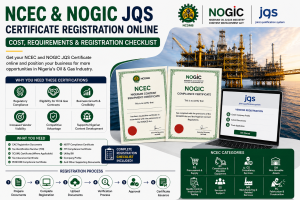
Before you can register for the Nigerian Content Equipment Certificate, you are required to fulfill this checklist of documents.
- CAC Registration Certificate
- Memorandum & Articles of Association
- CAC status report shoring Directors
- Means of Identification
- Audited financial statements
- Letter of intent to apply for NCEC (Must carry the company letterhead)
- List of equipments under the company
- Tax Identification Number (TIN)
- Utility Bill
- State equipment for which application is being made
- Name of Original Equipment manufacturer (OEM) (where applicable)
- Country of Origin of OEM (where applicable)
- List of equipment/component supplied to the Nigerian Oil and Gas industry in the past 10 years
- (Where applicable)
- Cost of equipment/component parts supplied to Nigeria in the past 10 years (where applicable)
- Details and evidence of activities already done
- Details of outstanding activities for establishment
- State proposed equipment cost in USD
- Name of manufacture’s representative in Nigeria
- Evidence of appointment as representative with responsibilities
- Percentage local content value i.e local value-added over total cost
- Total workforce (Nigerian vs foreign) and evidence of expatriate quota approvals (where applicable)
- Any information that will demonstrate activities
- Contact details of officer in charge
NCEC Certificate Online Registration in Nigeria
Before you can get the NCEC certificate in Nigeria, you will be required to first register on the NOGIC JQS website, create a company account and then proceed.
You can either sign up as an
- Individual
- Operator
- Service Provider
Follow the process below
- Send an email [email protected] and request that you want to register for NCEC certificate by attaching the following documents;
- CAC documents
- Contact phone number
- Contact address
- Valid NUPRC (DPR) Certificate
- Letter of intent to register with NCDMB
Upon receipt of this enail with the required details mentioned above, the JQS support team will proceed to create your portal account on their system and revert to you with the username and password
Ensure to change the default password and update the company profile information. This will enable the company profile information to be available on the NOGIC joint qualification system
Once you have done all of this, proceed and
Update your company modules service executed, staff management and basic information with the following submodules:
- Company profile
- Ownership document
- Shareholders
- Services Offered
Complete the whole application online, submit and wait for final approval
NCEC Certificate Registration Categories
The Nigerian Content Equipment Certificate (NCEC) is divided into different categories based on the nature of your company’s operations in the oil and gas industry.
When applying, businesses are expected to choose the category that best reflects the services they provide.
1. Procurement and Supply (PS)
This category is designed for companies involved in sourcing, supplying, and distributing equipment, materials, spare parts, tools, and other products required in the oil and gas industry.
Businesses that primarily act as suppliers or procurement contractors typically fall under this category.
2. Construction and Movable Equipment (EC)
This category is intended for businesses that own or operate movable equipment used in engineering, construction, drilling, dredging, lifting, transportation, surveying, and other field operations.
Companies with heavy-duty machinery and specialized operational equipment usually register under this category.
3. Consultancy Services (CS)
The Consultancy Services category is suitable for firms that provide professional and technical advisory services. This includes engineering consultants, project management firms, environmental consultants, legal consultants, financial advisers, and other specialists supporting oil and gas projects.
4. Non-Movable Assets (DA)
This category covers businesses that own fixed operational facilities or permanent infrastructure used to support oil and gas activities. Examples include warehouses, fabrication yards, storage facilities, workshops, operational bases, and other immovable industrial assets.
5. Quality Control, Inspection and Testing (QS)
Companies that provide inspection, testing, calibration, certification, laboratory analysis, quality assurance, and quality control services should apply under this category.
These services help ensure that equipment, materials, and operations comply with industry standards and regulatory requirements.
6. Services and Support (SS)
This category is meant for businesses that provide operational support services to the oil and gas industry. These services may include logistics, maintenance, equipment servicing, technical support, manpower supply, facility management, catering, waste management, security services, and other business support solutions.
7. Manufacturing and Related Services (MS)
Manufacturing companies that produce equipment, components, spare parts, industrial materials, or other products used in the oil and gas sector fall within this category.
It also covers businesses involved in equipment assembly, repair, refurbishment, maintenance, and related industrial activities.
8. Fabrication and Construction (FC)
This category is designed for companies engaged in fabrication, structural steel works, welding, pipe construction, plant construction, modular fabrication, and other engineering construction projects within the oil and gas industry.
It generally applies to firms that execute large-scale fabrication and infrastructure projects.
In conclusion, choosing the right NCEC category is an important part of the registration process. Applying under the wrong category may delay your application or lead to additional clarification requests from the Nigerian Content Development and Monitoring Board (NCDMB).
Before submitting your application, ensure that the selected category accurately reflects your company’s core business activities and available operational capacity.
Cost of NCEC Certificate in Nigeria
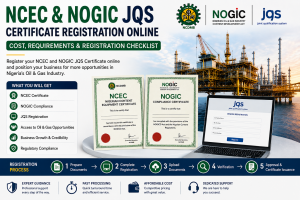
The Cost of NCEC certificate in Nigeria varies on the consultant doing the registration. The registration could cost between ₦150,000 to ₦300,000 depending on expertise, experience and status of the consultant.
The complexity of the company and its ability or inability to provide all required documents could also influcence the registration fee.
How Long Does Registration Take?
If all documents are provided, the registration usually takes around 2 weeks to complete.
Approved NCEC Company List
NCDMB usually publishes companies that have meet regulatory requirements and been certified with the NCEC Certificate. You can checkout and download NCEC Approved companies
How to Verify an NCEC Certificate
You can verify the Nigerian Content Equipment Certificate by scanning the QR code printed on the document or use the official extranet search portal by using the certificate ID to search and verify
You can also conduct both individual and company competence search
How Long is The Certificate Valid?
The validity of NCEC certificate is dependent on the category it was registered and issued under.
1. Category “A” Certificates expires after 2 years starting from the date of issue. This category typically applies to completed, functional, and operational local manufacturing or assembling facilities.
2. Categories “B”, “C”, and “D” Certificates are valid for just 1 year starting from the date of issue. This generally applies to equipment ownership, new facilities under development, or operational capacities.
Frequently Asked Questions
What is an NCEC Certificate?
The Nigerian Content Equipment Certificate (NCEC) is a certificate issued by the Nigerian Content Development and Monitoring Board (NCDMB) to verify equipment, assets, and facilities used by companies operating in Nigeria's oil and gas industry.
It helps promote local content by identifying equipment that is owned, leased, or available for use in oil and gas projects
What does NOGIC stand for?
NOGIC stands for the Nigerian Oil and Gas Industry Content Development Act. The Act was enacted to encourage the participation of Nigerian companies, promote local capacity development, and increase the use of Nigerian goods, services, and manpower in the oil and gas sector.
What is JQS?
JQS stands for Joint Qualification System. It is an online vendor qualification platform used by many oil and gas operators in Nigeria to pre-qualify contractors, suppliers, and service providers.
Companies register on the platform to become eligible for business opportunities with participating operators.
Is NCEC registration mandatory?
Whether NCEC registration is mandatory depends on the nature of your company's operations and the specific requirements of your clients or projects.
Companies participating in oil and gas contracts that involve equipment or facilities may be required to obtain an NCEC Certificate as part of their compliance obligations.
How much does NCEC registration cost?
The cost of NCEC registration depends on factors such as the registration category, the number of assets being registered, and any professional service fees charged by consultants assisting with the application.
Overall, this fee can cost between ₦150,000 to ₦300,000
What is the relationship between NCEC and NCDMB?
The Nigerian Content Development and Monitoring Board (NCDMB) is the regulatory body responsible for implementing the Nigerian Oil and Gas Industry Content Development Act.
The NCEC is one of the compliance initiatives administered by the Board to promote Nigerian content in the oil and gas industry.
What is the difference between NCEC and JQS?
The NCEC focuses on certifying equipment, assets, and facilities in support of Nigerian content requirements, while JQS is a vendor qualification platform used by oil and gas operators to assess and pre-qualify contractors and suppliers.
Depending on the nature of your business, you may need one or both
Conclusion

Comments 0
No comments yet
Be the first to share your thoughts.
Leave a Comment
Your email will not be published.